The chronicles of adding raw food to my diet

On this blog, I'll post about the transition to a more raw food based diet. Check back often for posts on raw foods that I'm eating!

Thursday, July 1, 2010

Stuffed Zucchini


I got some beautiful globe zucchini @ "my" farm, Stillman's the other day and decided to stuff 'em!

Over the weekend I stopped by the Marblehead Farmer's Market and got some of the first, local corn of the season (as well as local cherries and tomatoes). I used the corn for the stuffing, along with the tomatoes, avocado, grated beets, snap peas, sprouted quinoa, and lime juice.

Let's talk sprouting quinoa. Quinoa is an amazing seed that everyone should be eating. It can be sprouted and it can be steamed. It is contains all the essential amino acids that the body needs to ingest (as opposed to producing itself). It is also alkaline forming, meaning it will not cause your body to become acidic; acidic bodies are more prone to getting illnesses, while those more alkaline are known to have less illness.
If you are going to sprout quinoa, make sure you know the source from where you are getting it. I buy raw, sproutable quinoa. If you get the quinoa in the box or from the bins @ Whole Foods, be sure to watch it closely as it may mold over more quickly.
You can purchase the raw, sproutable quinoa from Raw Food Naturals.

To sprout the quinoa, soak it for a minimum of 3 hrs. Sometimes I just put it up to soak overnight because its easier to just set it and forget it.
After the soak, give it a healthy rinse with water and then it will start to sprout. The sprouting time is very quick and you can see the tail form as soon as 8 hrs in. I like to sprout it in a fine mesh strainer that I leave by the sink. After the first rinse, let it sit, then give it another rinse 8 hrs later. Let it go overnight and the next morning, rinse again. It should be ready to eat now, but you can let it go longer if you'd like. After the 2nd day I would suggest putting it in a glass container and put in the fridge. It will keep for about a day more and that's it. I have learned to sprout only what I can eat in a day or so because the shelf life is so short.
Here's the quinoa after about a day :

When I was ready to stuff the zucchinis, I first hollowed them out:
I brushed the inside of the zukes with a nice coating of cold pressed olive oil, and a gave them a sprinkle of salt as well.
I then took the mixture I described above and stuffed the zukes with it. Here's a pic before I mixed in the sprouted quinoa:

I dehydrated them at 105 degrees for about 12 hrs.
So, they were pretty good. I think that they could have gone a bit longer in order to soften up the zucchini a bit more. They were just very deep and stuffed pretty much all the way, so dehydration was not even throughout the entire zucchini. I will make this again using regular zucchini and I think they'll probably "cook" through a bit more evenly.

Get out and enjoy the local bounty!!!
Eat something raw today!

Saturday, June 26, 2010

Community Supported Agriculture (CSA)

I'm sure most of you reading this know what a CSA is, but for those who do not, it is Community Supported Agriculture. Basically, it is a way that you can get involved with your local farms, by buying a "share" of the farm. Most farms either deliver to you once a week, or you go to the farm to pick up a cut of what the farm is harvesting that week. It is hands down, the best way to get the freshest produce out there (short of growing it yourself). For more information about farms in your area that offer CSAs, check out localharvest.org.
The farm that I have been a member of for years is Stillman's Farm. It is a family run farm out of Western, Mass that offers both a produce CSA and a meat CSA. I am as proud to support both CSAs as I am honored to support them. Their produce and meats are exemplary and I am excited each week to get my share....(the meat pick-ups are once a month and the CSA runs through the entire year).
So, it's probably not too late to check out if there is a farm in your area that offers a CSA program. Look into it, you will not be disappointed, especially if you are shelling out cash a couple times a week to Whole Foods or some other store. If you were to buy the amount of fresh, local and conscientiously grown food that you get from the farm at Whole Foods I guarantee you'd be spending far more than what your share will cost you. It's worth it!!!

Sunday, June 13, 2010

It's easy to grow Wheat Berries and Sunflower Sprouts

I do a ton of sprouting...clover...alfalfa...garbanzos.....lentils....adzukis....broccoli....you get it.. whatever I can sprout.....those seeds/beans are sprouted w/out soil, usually in glass jars or some other sprouting device.
I'm just getting into sprouting wheat berries for wheatgrass juice, sunflower sprouts and peas, which are done in soil. As part of my Life Force Energy class, we got to sprout both wheat berries and sunflower sprouts, which was surprisingly easy to do.
You first soak your wheat berries (Hard Red Winter Wheat) and sunflower seeds (Black Oil sunflower seeds) overnight in water. The size of the tray will determine what volume of seeds to soak.
The trays are filled with soil; I use a top soil mix w/peat moss and enrich it with glacial rock powder. After the over night soak, drain and rinse the wheat berries and/or sunflower sprouts and press them into the soil.
It's best to dedicate trays, but for our class, we split 1 tray each to get started.
Gently water to make sure soil is moist, and then cover with another tray. Water again in the evening. Repeat this for 3 days, and the sprouts will actually start to push up the tray that is laying on top of it. At this point, remove the top tray and give the sprouts indirect sunlight and continue to water 2-3 times daily, depending on soil moisture.

Day 2:
Day 4:

Day 7:
Harvest the wheatgrass when you see a second, smaller piece of grass growing out of the first, ~7-10 days. The sunflower sprouts are harvested when you can see the second pair of leaves starting to grow with the larger, top pair of leaves, also ~7-10 days.
The wheatgrass obviously you juice into wheatgrass juice...the sunflower sprouts can also be juiced, or eaten straight up, they are delicious and sweet.

Eat something raw today!

Thursday, June 10, 2010

Raw Portobello "Parmesan"

Hands down, this is the best raw food I have prepared to date.
Using the raw marinara that I blogged about here, and a cashew "cream", I stuffed portobellos and dehydrated them. The result was a melt in your mouth, delicious, velvety, yet savory and filling dish.

Let's talk about the cashew cream. The recipe came from an amazing blog, called Rawmazing. The recipe that follows is my adaptation:
Cashew Cream
1 cup cashews, soaked until soft, drained and rinsed
1/2 cup young coconut meat
2-3 TBS young coconut water (I actually used a bit more than this)
1 small garlic clove (I used only 1/2 a clove since I find garlic can easily overpower a raw recipe)
Pinch Celtic Sea Salt
Pinch of fresh ground black pepper
2-3 TBS fresh chopped cilantro (You can use any herb that you like)

To prepare, simply put all ingredients except cilantro in a high speed blender and blend until a smooth consistency is achieved. Stir in the fresh herbs and check your seasoning; adjust accordingly.
Cashews are a great nut to make creamy sauces out of, including ice creams! That is for another blog...

Next you need to prepare the portobellos. Remove the stem and then use a small spoon to gently scrape out the gills. Once the gills are cleaned out, drizzle a bit of extra virgin olive oil across the area where the gills were, and season with Celtic sea salt and pepper.
Now, layer in your sauces, first the raw marinara, then the cashew cream.

That's it. The portobellos are ready to go into the dehydrator. I chose not to use a Teflex sheet, but rather put the portobellos on the screen instead. I dehydrated them at 105 for ~8 hrs.
The portobellos softened up beautifully, and the marinara and cream sauces both firmed up a bit, creating a pleasing texture. The taste was off the hook.
I enjoyed them so much that I wanted, no strike that, I NEEDED to make more! I didn't have any more portobellos, but I did have a zucchini, so I decided to try it with that. I added on a sprinkle of nutritional yeast as well, and dehydrated it at 105 for ~8 hrs. Here is a pic, prior to dehydrating:
Delicious....I have another batch of portobellos in the dehydrator as I type. DO TRY THIS AT HOME!!!!
:) Eat something raw today!

Friday, June 4, 2010

Raw Marinara Sauce

It's almost (not quite yet) tomato season, and I can't wait. In the meantime, using sun dried tomatoes is a good way to get your tomato dose in. You can use both fresh tomatoes and sun drieds to make a robust, raw marinara sauce.

First off you need to soak your sun dried tomatoes (~1 cup) to rehydrate them; to keep it raw, soak for about 4 hours in lukewarm water. After soaking, drain the tomatoes, reserving the soaking water to use to thin out the sauce as you process. Put the soaked tomatoes in a high speed blender.
In the meantime, rough chop 5-8 Roma tomatoes, depending on size, a garlic clove, 1-2 tsp fresh oregano and thyme, and a handful of fresh basil. Put all of those ingredients in the blender with the sun drieds.

Add the following to the blender: juice of 1 lemon, 2 TBS best quality cold pressed olive oil, 3 dates (pitted) and sea salt to taste.
Process the ingredients, adding the soak water to thin as necessary. Season with S+P to taste after processing. The consistency of the sauce will vary based on your preference.


So, what do you eat the sauce with? Well, to keep it raw, you can make "pasta" out of veggies. I used zucchini, summer squash and carrots.
I used a tool called the Spirooli Spiral Slicer. Its basically a tool with 3 different blades that can be used to cut vegetables into thin cut slices, or 2 different size spiral slices.
Here's a pic with the zucchini in place:
Here are a couple of pics of the veggies as they come off the blade:

And the finished product:

Before I sauce the noodles, I add a pinch of salt and a squeeze of lemon juice to soften them up a bit.
Though not totally raw, but enjoyed by raw food enthusiasts, for a cheesy taste like Parm cheese, you can top the sauce and noodles with some nutritional yeast.

I had a bunch of sauce left over, so I took some and added ground flax to it and then blended it together in the high speed blender. I spread it on the dehydrator sheet and dehydrated it into a tomato wrap. Today I enjoyed it filled with sprouts, avocado, grape tomatoes, hemp seeds and a sprinkle of nutritional yeast:
Enjoy! Eat something raw today!

Monday, May 31, 2010

Stocking my Raw Foods Kitchen

Where do I get my ingredients to stock my raw kitchen? Well, I do a lot of shopping on the internet. Whole Foods has a fine assortment of ingredients as well, but I do find their prices to be on the higher side, and they don't have everything I need to stock my raw kitchen with the hard goods.

One internet shop I like to buy from is Raw Food Naturals. They have a great assortment of the essentials that you need to eat on a day to day basis: nuts, seeds, nut and seed butters, raw food bars, raw food snacks, raw oils (think coconut, hemp etc), dried fruits and superfoods (gojis, mulberries), superfood powders for smoothies, sweeteners, the list goes on....and the best thing about this online store is it's excellent customer service.

Another internet site I buy from is The Raw Food World. Their site is bigger than Raw Food Naturals, as they offer equipment and appliances and other kitchen tools you might need. Their prices are competitive and they have a ton to offer.

I think that stocking the raw food kitchen is the most important thing to being successful on a raw foods diet. If you don't have the ingredients to prepare foods, you're going to then be at a loss at what to eat, and that's when you'll go back to the SAD (standard American diet).
So, lets chat a bit about what's in my kitchen. This is not an inclusive list, but highlights some of the hard items that have made it easier for me to add raw foods to my diet. When purchasing these ingredients, always chose the "raw" option. If it doesn't say raw, it isn't raw.....

1) Nuts and Seeds/Nut butters/Seed Butters:
Almonds - a must have nut in my kitchen, to make almond milk, "refried beans", a variety of raw bars, cookies, and treats
Cashews - excellent for making cashew cheese and creamy desserts, like ice cream (non-dairy of course)
Sunflower seeds - again, a must have seed for making a nice veggie pate, which can be used in rolls and wraps
Flax seeds - Huge in Omegas and great to act as a binder for crackers and breads
Hemp Seeds - possibly my favorite seed right now, hemp seed is packed with Omegas, protein and they are delicious on salads.
Chia Seeds - I know, Chia, you say? Yes Chia. The chia seed is an excellent seed to make into puddings, crackers, to add to smoothies etc. It is a nutritional powerhouse as well, high in fiber and protein.
Quinoa - quinoa is actually a seed and not a grain. I sprout it or cook it and eat it. I love it - it contains all the amino acids needed to make a complete protein and so is a good choice for vegans/vegetarians.
Raw Almond butter - Yum. Enough said.
Raw Sesame Tahini - perfect for making hummus and other pates.
Other nuts are great to have as well, such as pine nuts, macadamia nuts and the other tree nuts (walnuts, pecans, Brazil nuts); unfortunately, I am allergic to the other tree nuts so I can't enjoy them.
Sprouts
Sprouts are a powerhouse of nutrition. If you think about it, each tiny seed has everything inside of it necessary to make a plant. When you sprout a seed, and all of that nutrition comes out into the tail, you have life - all amino acids necessary to grow that plant are right there, ready to eat. Imagine what the sprout can do in your body? It's completely bio-available nutrition.
I sprout whatever I can - a variety of dried peas, beans (azuki, garbanzo, lentils) and seeds (clover, alfalfa, broccoli). The possibilities are endless.
Sunflower sprouts are also extremely nutritious. I have grown my own in the past, in soil, and I am currently getting set up to grow them as well as wheatgrass.

2) Sweeteners:
Raw Honey - honey that is unheated, unprocessed straight from the hive. Look for honey local to your area
Lucuma powder- this powder is a great sweetener - it comes from the fruit of plant in Peru and has a great caramel flavor.
Maple Syrup, Grade B - this grade of maple syrup is often not sold in conventional mkts. It is the least processed of syrups and has more minerals than the Grade A you find at the store.
Agave syrup - I'm still not convinced that this syrup is as bad as HFCS. Yes, it is high in fructose, but it still is low glycemic, not spiking the blood sugar as high as refined white sugar.
Mesquite Powder - this powder comes from the pod of the mesquite bean and is a pleasant sweetener. It has protein in it as well as vitamins and minerals.
Dates - dates are high on the glycemic scale and so for some people, such as diabetics, they are not ideal to consume. I love dates and I use them to make bars and cookies, to sweeten up almond milk and to round out the flavor in some savory soups and sauces.
Yacon Syrup - I'm just getting into this sweetener. It is delicious, reminiscent of molasses. However, it is extremely expensive.

3) Superfoods:
Raw Cacao pwder and nibs - yum, just yum. Nibs are great for a pick me up and to put in raw bars and cookies as well as trail mix. The powder has endless possibilities, cookies, smoothies, bars, ice cream, nut milks, you get the idea
Dried Goji Berries - a berry native to Asia, high in protein, good carbs, fiber and fat
Dried Mulberries - an antioxidant powerhouse!
Cacao Butter: Not used that much in my kitchen, but delicious to use in raw chocolates and other treats.
Coconut - I'm putting coconut under superfood because I think it's super - high in medium chain fatty acids and capryilic acid (natural antimicrobial agent), as well as electrolytes. Both the meat and water are a great addition to your kitchen.

4) Oils/Condiments:
Coconut oil/butter - excellent for adding to bars, smoothies and other treats
Cold pressed extra virgin olive oil
Hemp oil - see hemp seed above
Apple Cider Vinegar - many health benefits from apple cider vinegar, including anti-bacterial properties, increases metabolism, and helps fight allergies to name a few
Nama Shoyu - similar to soy, but naturally fermented
Bragg's Amino Acids - liquid protein that has a soy like flavor, vegetarian

5) Grains:
Millet, Amaranth (and quinoa): all of these will alkalize the body and can be sprouted.
Hard Red Winter Wheat - for growing wheatgrass and for sprouting to make raw, dehydrated breads
Oats - for soaking overnight to make raw oatmeal or to make into raw cookies and bars
Buckwheat - for soaking overnight to make raw porridge or to dehydrate into buckwheat "crispies" to eat as cereal, also to make into raw cookies and bars

So, these are some ingredients in my kitchen. Again, the list is not complete, there are many other ingredients that I have probably forgotten :) Contact me for more information :)
Eat something raw today!

Thursday, May 6, 2010

Raw Nori Rolls

I am currently taking a 10 week course called Life Force Energy, The Hippocrates Approach to Optimum Health. The Hippocrates Institute was founded in Boston, in the 1950's by a woman named Ann Wigmore. She was one of the earliest pioneers of raw and living foods. Hippocrates is now located in Florida and people go there to get healthy and to learn about raw and living foods.
A special woman named Betsy Bragg runs the Life Force Energy course here in the Boston area, and at the end of the 10 weeks, I'll be a certified educator in the Hippocrates approach to healthy living.
All of the proceeds of the course go towards a program that Betsy has started in the Boston school system to teach the children and teachers about raw and living foods, health and nutrition and about gardening; the Martin Luther King Jr Elementary School in Dorchester, Ma is lucky enough to have this program. Truly an amazing program that is giving the opportunity to kids to learn about where their food comes from. To learn more about the program, check out the website for Optimum Health Solutions.
Just in the first 3 weeks of the course, I have learned so much about raw and living foods, sprouting, juicing etc. It's great.
Today in class, we made raw nori rolls and they were so yummy, I stopped on my way home to pick up some nori to make the rolls at home.
What is nori?
Nori is seaweed, and you probably know if from "maki" in sushi restaurants:
This nori is raw and untoasted as opposed to "toasted" nori which is also available. Nori is a sea vegetable and is packed with nutrients. Just one sheet has 13 calories, 1.2g fiber, 1.2g protein, Vitamins A and B, iodine, carotene, calcium, iron and zinc. Because it is raw, the nutrients are highly bioavailable and digestable.

Now, most sushi rolls are filled with rice and some type of veggies and fish.
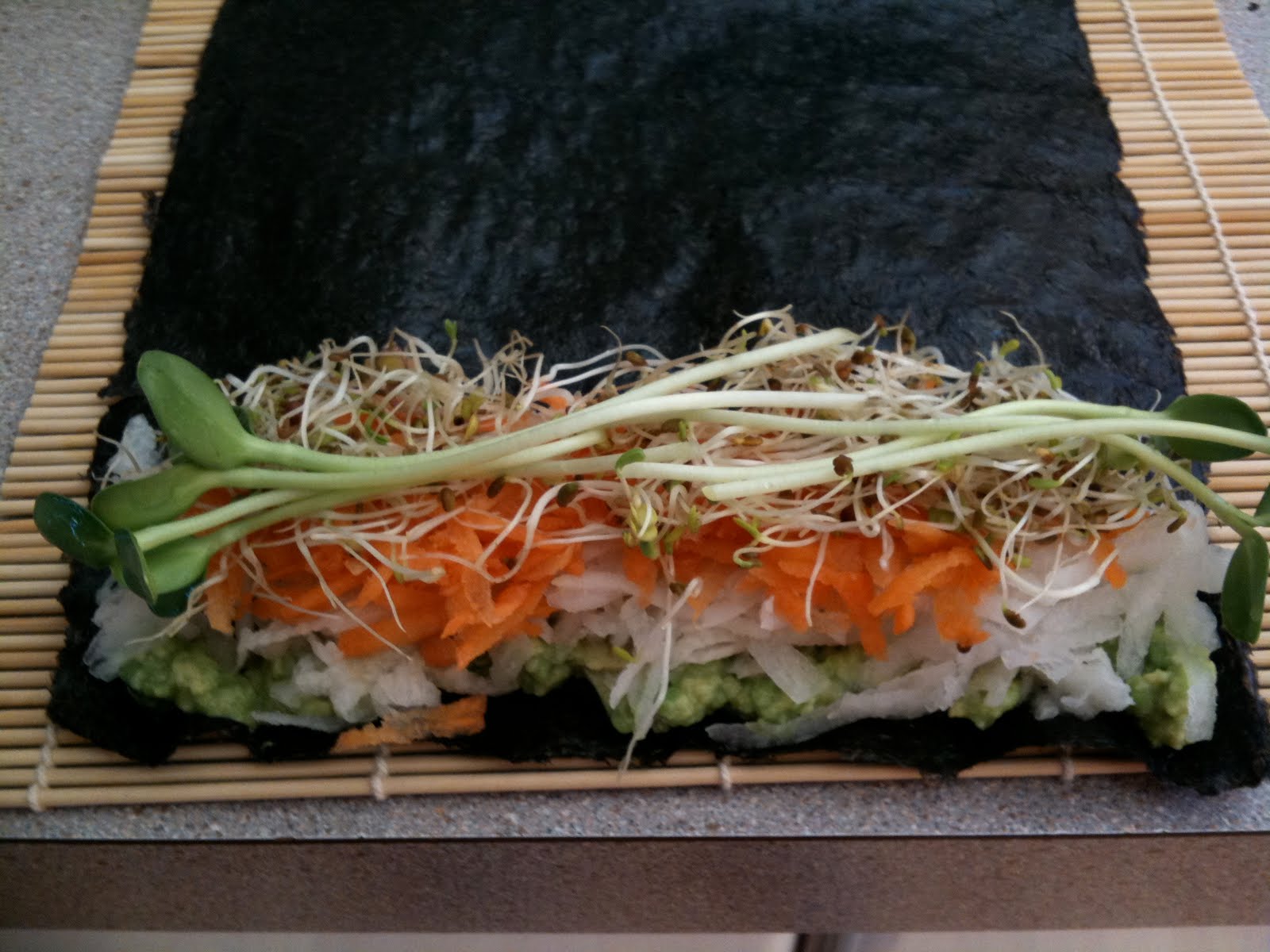
The sushi rolls I made today are raw, so they do not contain rice or fish. Instead, jicama and daikon radish are used to simulate rice, and a variety of veggies are used as filling. For more protein, a nut or seed pate can be used as well, however, I didn't have any pate kicking around. I used mashed avocado for flavor, and mouth feel (plus healthy fats). I used Shoyu, a naturally brewed or fermented soy sauce to seal the rolls.
Most soy sauces are heated during processing. Shoyu is not heated and so is considered raw.

Here we go: 1 sheet of nori on my sushi rolling mat:


Grated jicama, daikon and carrots:

Building the roll with the avocado, jicama, daikon, carrots, alfalfa sprouts and sunflower sprouts:
Rolling the nori:
The finished roll that I sealed with the shoyu (usually water is used, but I like using shoyu since it adds more flavor):


The finished roll:

Warning: These rolls are highly addicting!!!
:) Try something raw today......